IWLOP #059 - Manilius
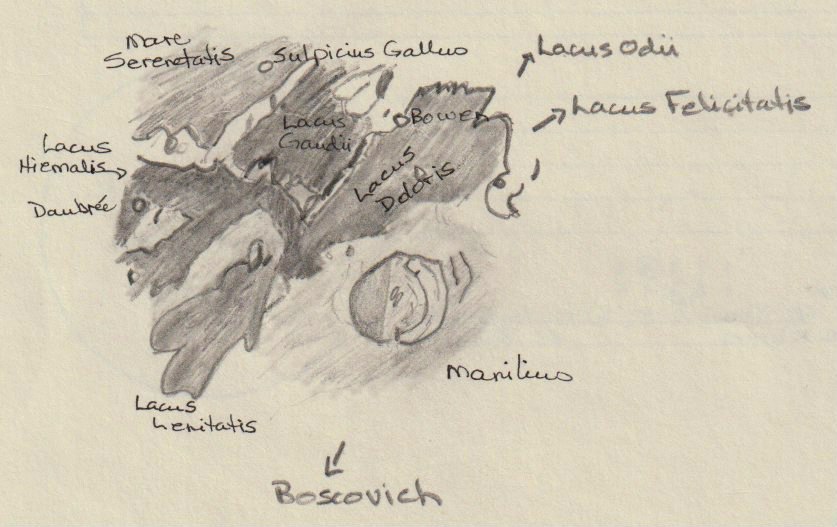
Deep (3.2 km) terraced crater with high (2.6 km) central peak. Eratosthenian-age crater.
Location: 14.5 N 9.1 E Origin: Impact Size: 39 km Rukl: 23, 34 Type: Complex Crater (CC)
Objects: Manilius, Mare Serenitatis
Others Identified : Boscovich, Bowen, Daubrée, Lacus Lenitatis, Lacus Hiemalis, Lacus Gaudii, Lacus Doloris, Lacus Odii, Lacus Felicitatis, Mare Vaporum, Sinus Fidei, Sulipicious Gallus, Yangel
Observation #1:
Location: Home
Date: 2021-04-19
Time: 8:09 PM ADT
Equipment: 10" Meade SCT
Eyepiece: Explore Scientific 4.7mm with 82° FOV + x2 Barlow
Magnification: x1060
Seeing: Very Good (2)
Transparency: Good (3)
R1: Manilius was found on the eastern shore of Mare Vaporum. Circular and deep with west inner rim looking ridged (or slumped?). Several lakes to its west and north - Lenitatis, Hiemalis, Gauldi, Doloris, Odii, Felicitatis - and Sinus Fidei.
C1: Banding on the floor was observed. Its centre peak looks like two.
C2: Did not view the ray material over Mare Serenitatis in this session.
Observation #2:
Location: SCO
Date: 2026-05-23
Time: 10:08 PM ADT
Equipment: 10" Meade SCT
Eyepiece: SvBony Zoom 30mm-10mm
Magnification: x86-x250
Seeing: Good (3)
Transparency: Good (3)
C2: At Q-day 0, this part of the lunar surface was very well illuminated. I noted a bright ray seemingly emanating from Menelaus that passed over Bessel then continued on past a couple of smaller craters towards Luther. There were much fainter rays radiating out from north to south (or were these ridges on the Mare floor?). I did not sketch what was observed.
Found when creating this entry: The 21st Century Atlas of the Moon (Charles A. Wood/ Maurice J.S. Collins) is perhaps the very first lunar atlas which has a name for the mysterious high-albedo ray
running across Mare Serenitatis and crater Bessel. This ray is one of the most stubborn riddles in the history of moon observing and selenography. What is the source
of this remarkable singular ray of ejecta? Is Bessel the source? Or is it a crater to the north of Mare Serenitatis? Or perhaps to the south? It's very strange that
this kind of pronounced rays (ejecta rays from impact craters) don't have official IAU names. Chart 11 (page 35) in the 21st Century Atlas of the Moon shows
the informal name Bessel Ray just north of crater Bessel.