Click on the image to view it at full resolution, then click again for actual size.
Click on the image to open it at full resolution.
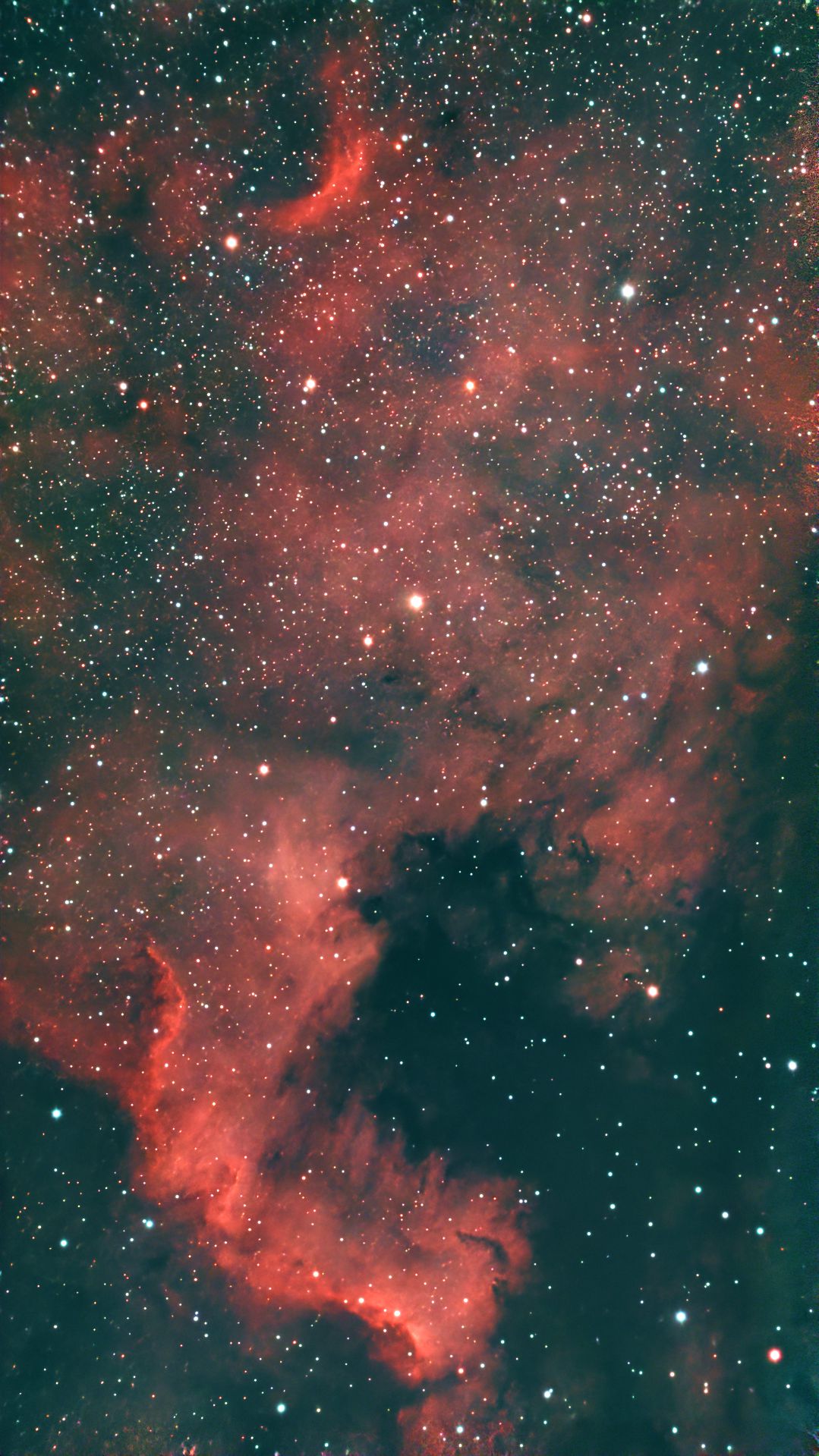
The NGC 7000 The North America Nebula is a large emission nebula in the constellation Cygnus, named because its outline resembles the continent of North America in wide-field images. It lies along the rich star fields of the Milky Way near the bright star Deneb and forms part of a broader complex of glowing hydrogen gas. The nebula shines primarily from hydrogen-alpha emission, produced when ultraviolet radiation from nearby hot, young stars ionizes the gas and it recombines.
NGC 7000 is separated from the neighboring Pelican Nebula (IC 5070) by a dark dust lane often called the “Gulf of Mexico,” where dense interstellar dust obscures the background starlight and nebular glow. Within the nebula are regions of active star formation sculpted by stellar winds and radiation, creating bright ridges, arcs, and cavities embedded in the larger cloud. [general astronomy reference/Wikipedia-style summary]
Total image time was 3.95 hours.
Moon Phase
Waxing Gibbous phase (very nearly full, about 99% illuminated