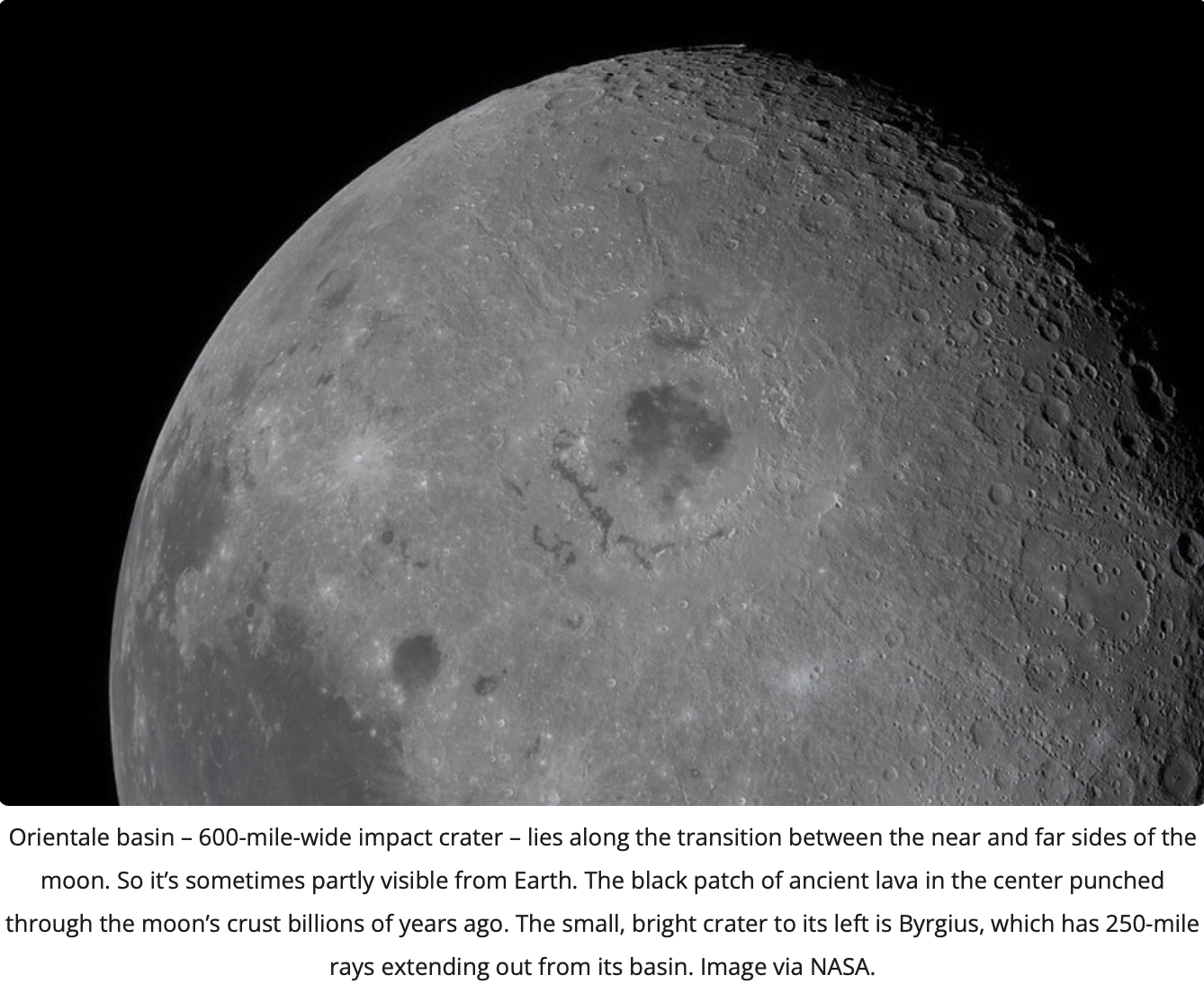
Mare Orientale is one of the youngest major impact basins on the Moon, and the visible effects of that gigantic impact are widespread on the extreme western area of the Moon.
Origin: impact and volcanic Size: 640 km Rukl: 50, 39. VII Type: Basin - Mare
Objects: Mare Orientale, Montes Cordillera
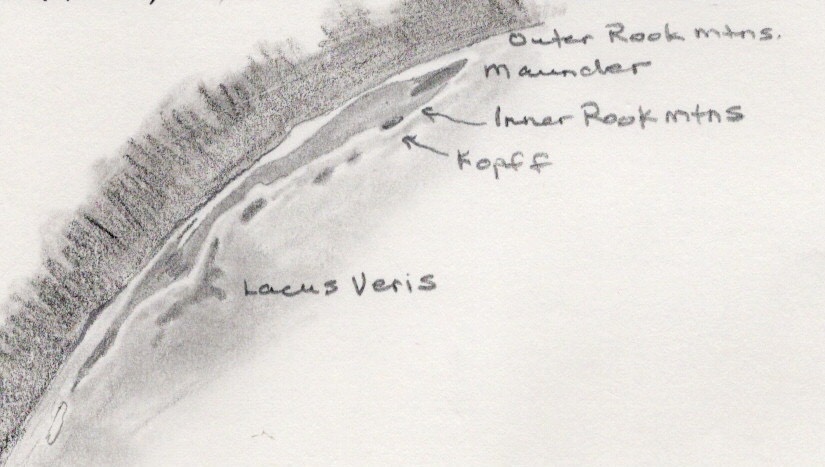
Others Identified: Schlüter, Hartwig, Kopff, Maunder, Montes Rook (Inner & Outer), Lacus Veris
Observation #1:
Date: November 2, 2025
Time: 7:17 PM AST
Equipment: 10" Meade SCT
Eyepiece: 10mm
Magnification: x250
Seeing: Excellent (1)
Transparency: Excellent (1)
Libration: -5.8° I had marked my calendar for November 1 - 3 as ideal to capture this landmark - and I was correct. Easily located this elongated feature on the SW limb.
C1: The Mare had a dark floor compared to surroundings. From the perspective I had during the libration, the Montes Cordillera and Outer Montes Rook were low, very well lit and white on the side facing Oceanus Procellarum. The lunar limb was irregular in shape suggesting it was a mountain range on the other side of the Mare - also perhaps the Outer Montes Rook on the lunar far side. The dark oval-shaped crater in the northern portion made me think it could be Maunder. A little south of Maunder was another dark formation/crater that I tentatively identified as Kopff.
There was a stretch of dark patches in front of the Mare that identified as part of Lacus Veris. A light stretch that outlined the Mare Orientale was perhaps the inner Montes Rook.
Not sketched but identified were two craters north of the Montes Cordillera - Schlüter and Hartwig. Schlüter was closer to the rim and darker than Hartwig; both, perhaps because of the libration, appeared oval.
Observation #2:
Date: June 9, 2026
Time: 5:00-5:30 AM AST
Temp: 8° C
Equipment: 10" Meade SCT
Eyepiece: 30mm
Magnification: x83
Seeing: Good(3)
Transparency: Good (3)
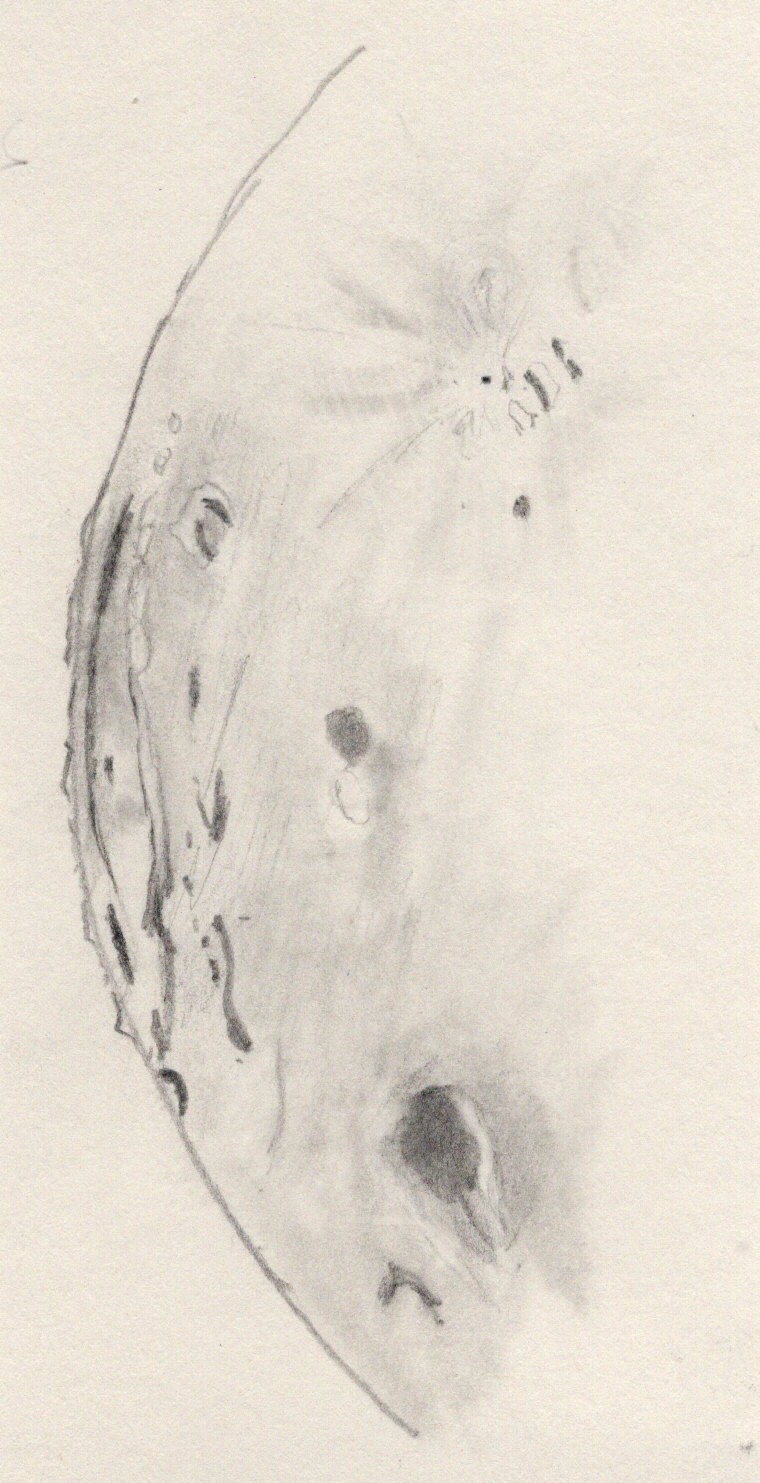
Others Features Identified: Byrgius, Cavendish, Darwin, Doppelmayer, Gassendi, Grimaldi, Henry, Henry Frère, Letronne (partial), Mare Humorum, Riccioli
Moon was viewed in daylight. Waning 40.4%. Libration -7.8°. High cloud cover at 5 AM meant the moon was obscured enough so that no detail could be discerned. Once the clouds disappeared it was good seeing and transparency, but with a lower magnification fewer details were seen.
However, there did seem to be more to see between the mare rims this time around. The limb was ragged in the upper and lower portions of the mare; the mid-section was much smoother in comparison. The far edge of the Mare appeared darker than the previous observation, and there was more of the floor to observe.
The crater Byrgius (near Cavendish, Henry and Henry Frères) had a wide ejecta field despite its small size.
NOTE:
What makes this objective exciting for me was Artemis II had this object as one of their targets and to see it fully develop by the astronauts as they flew on the lunar far side on April 6 was amazing. This mare is 1000 miles / 1629 km across and NASA described it as the distance between Houston and the Kennedy Space Centre. To put this in a Canadian perspective, that approximately equates to the distance between Saskatoon and Vancouver. I watched the NASA broadcast during the time of approach by the Artemis crew and while flying past this Mare. I attempted to follow the astronauts' route using my moon globe, my Sky&Telescope lunar map (for the nearside) and a lunar map on my iPhone. It was so exciting to compare what I had sketched with the photos taken by Canadian astronaut Jeremy Hansen!
NASA Image