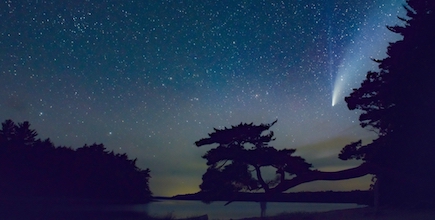
The eclipse postings on RASC discussion lists to date have been of images - both still and time-lapse. They have been phenomenal! However, on March 14, 2025, I chose 10x42 IS binoculars, a pre-printed map of the Moon and my SQM* as my observing tools of choice.
We were in our backyard where we had full view of the orb during our observing session 1am-4am. With battery operated gloves and socks and sandwiched between two sleeping bags on our park bench, we enjoyed the show the Solar System offered.
I drew the lines as the Moon's surface was darkened by the Earth’s shadow up until 3:30am. However, in totality at 4 am, there was still what we referred to as a ‘polar cap’ on the N-NE limb. We did not observe past 4am to determine the timing of the re-illumination of the lunar surface.

- 3:03am: SW limb showing hints of pink visually and in binoculars
- 3:30am: ‘polar cap’ still looked to be illuminated on its limb but no features could be discerned in binoculars.
- 3:38am: ‘polar cap’ now turned pinkish but not as bright.
| Time (AM ADT) |
SQM |
Temp. (° C) |
| 1:25 | 17.64 | not taken |
| 2:14 | 18.14 | not taken |
| 2:29 | 18.50 | -5 |
| 2:47 | 18.57 | -6 |
| 3:01 | 19.02 | -7 |
| 3:11 | 19.15 | -7 |
| 3:19 | 19.15 | -7 |
| 3:30 | 19.18 | -7 |
| 4:00 | 19.22 |
-8℃
|
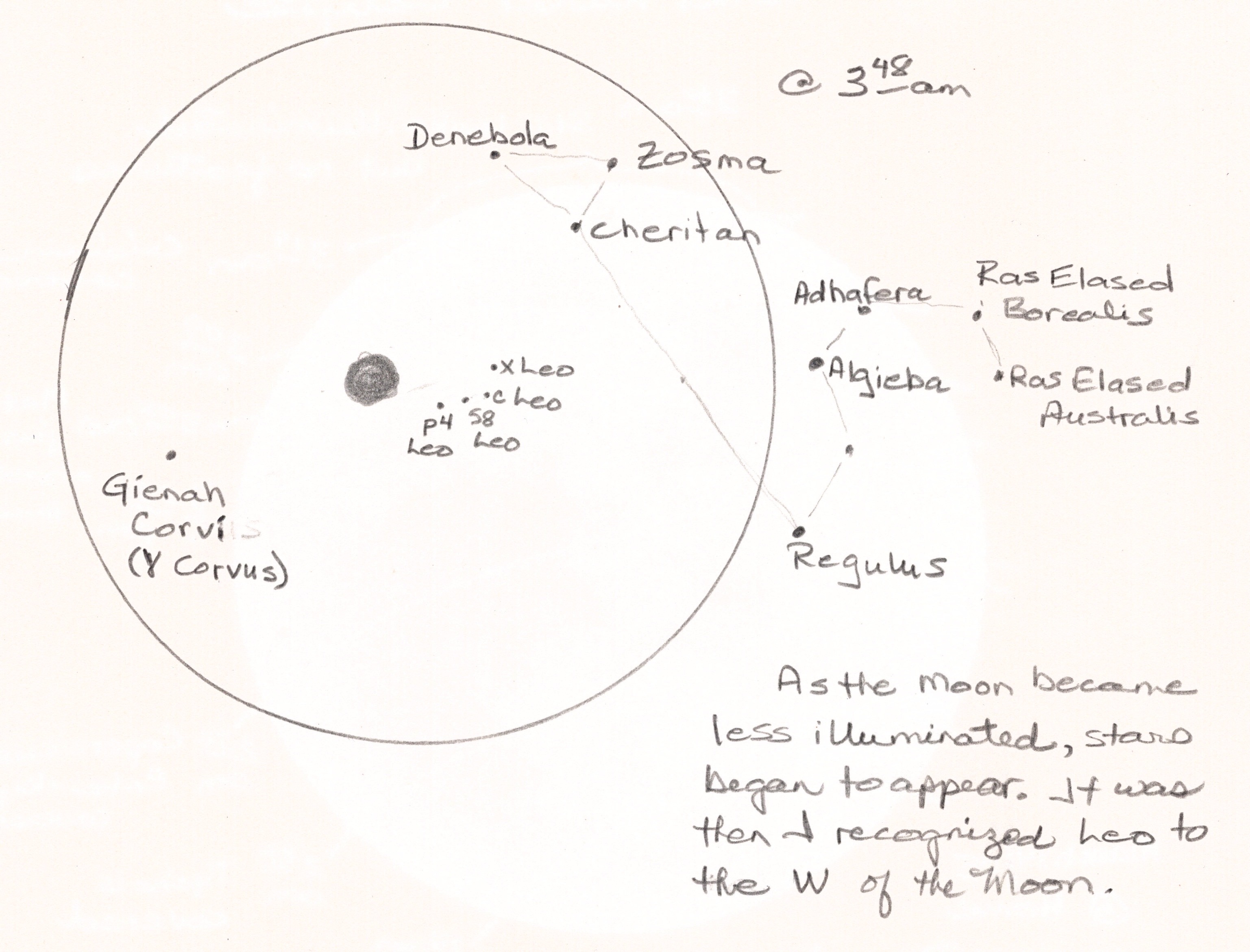
Sometime between 3:30am and 3:50am we noticed that stars were visible in Jerry’s telescope and now my binoculars.
* typically used by amateur astronomers to quantify the sky glow aspect of light pollution, and uses units of "magnitudes per square arcsecond" favoured by astronomers.