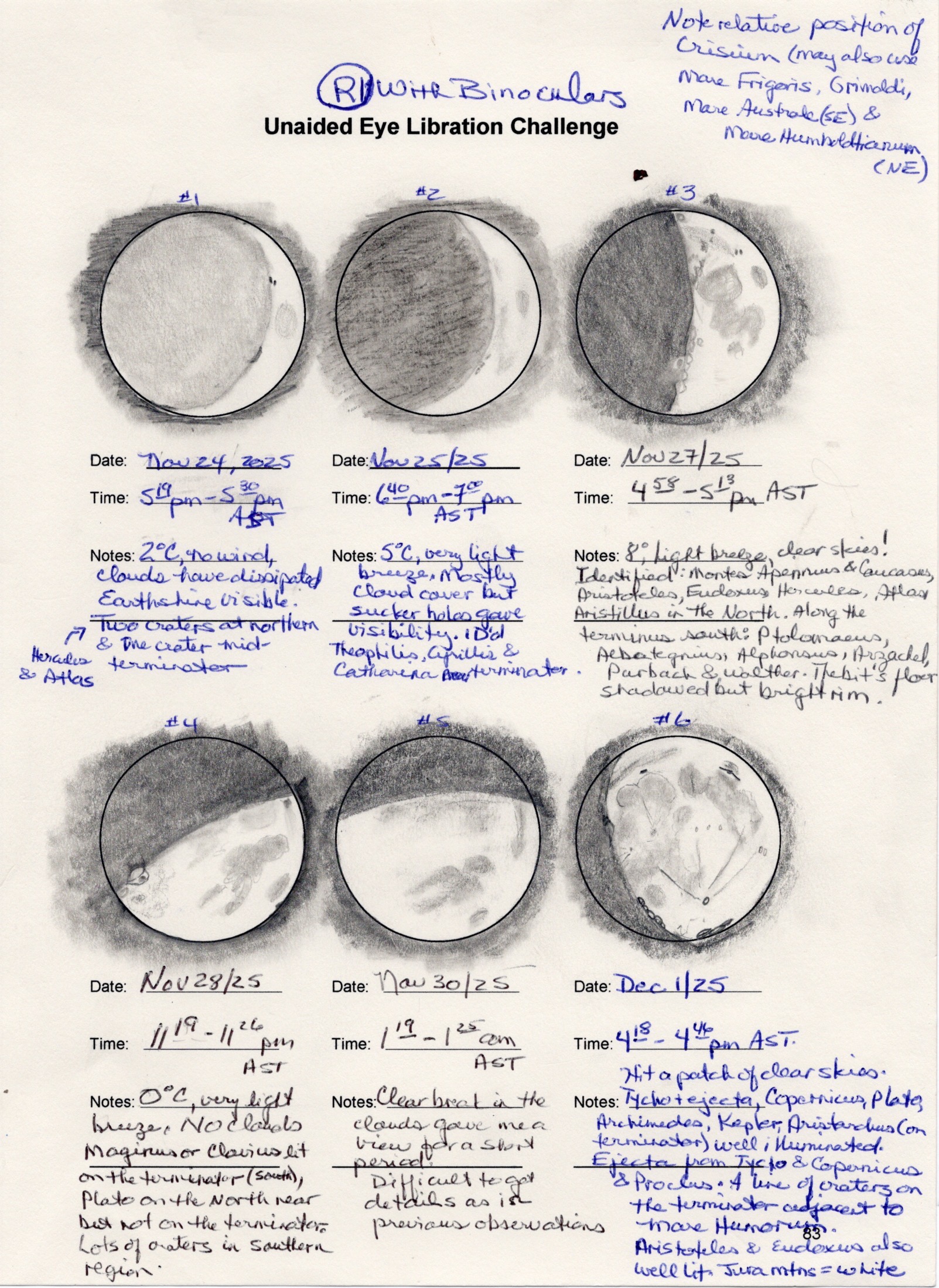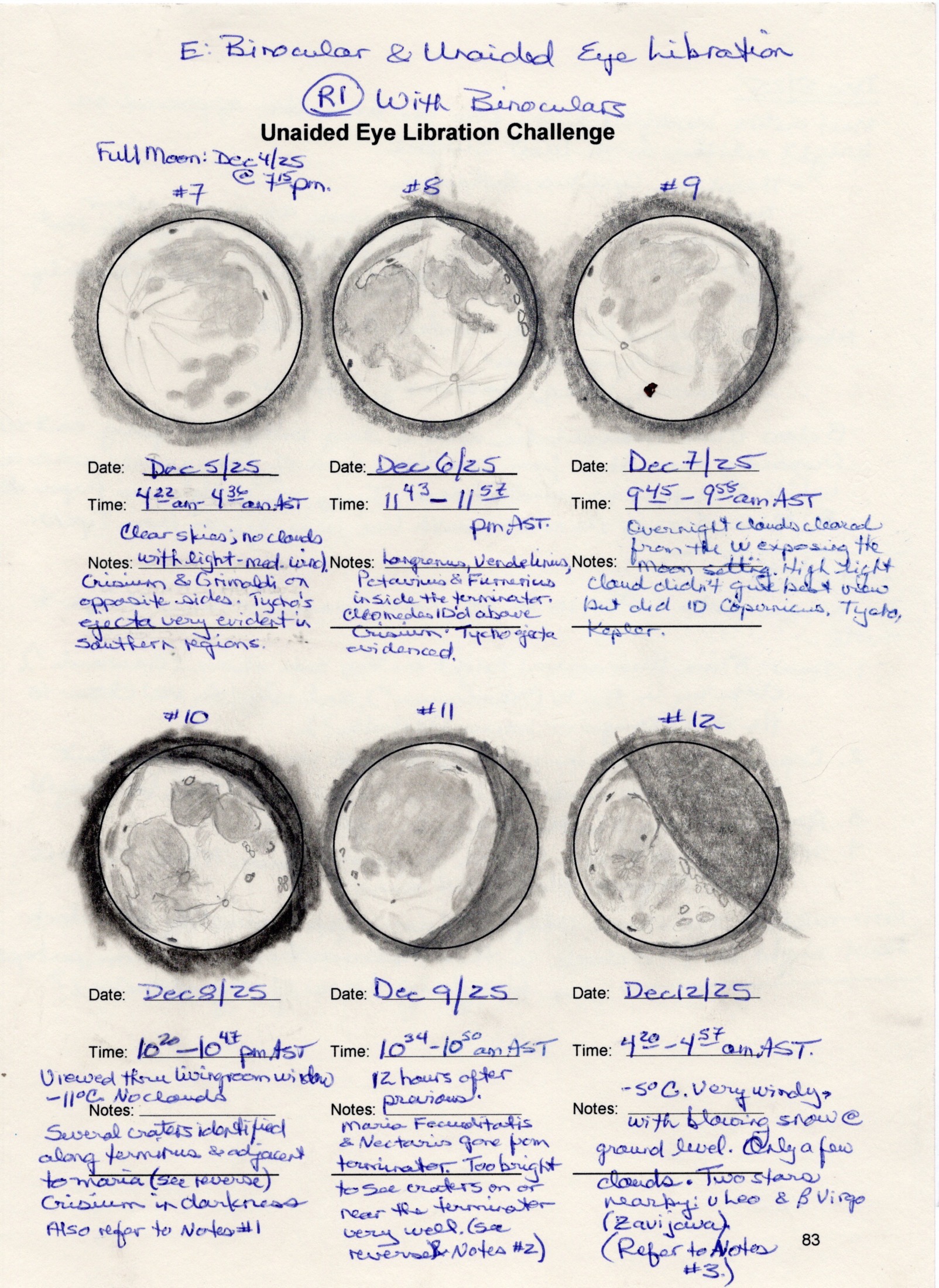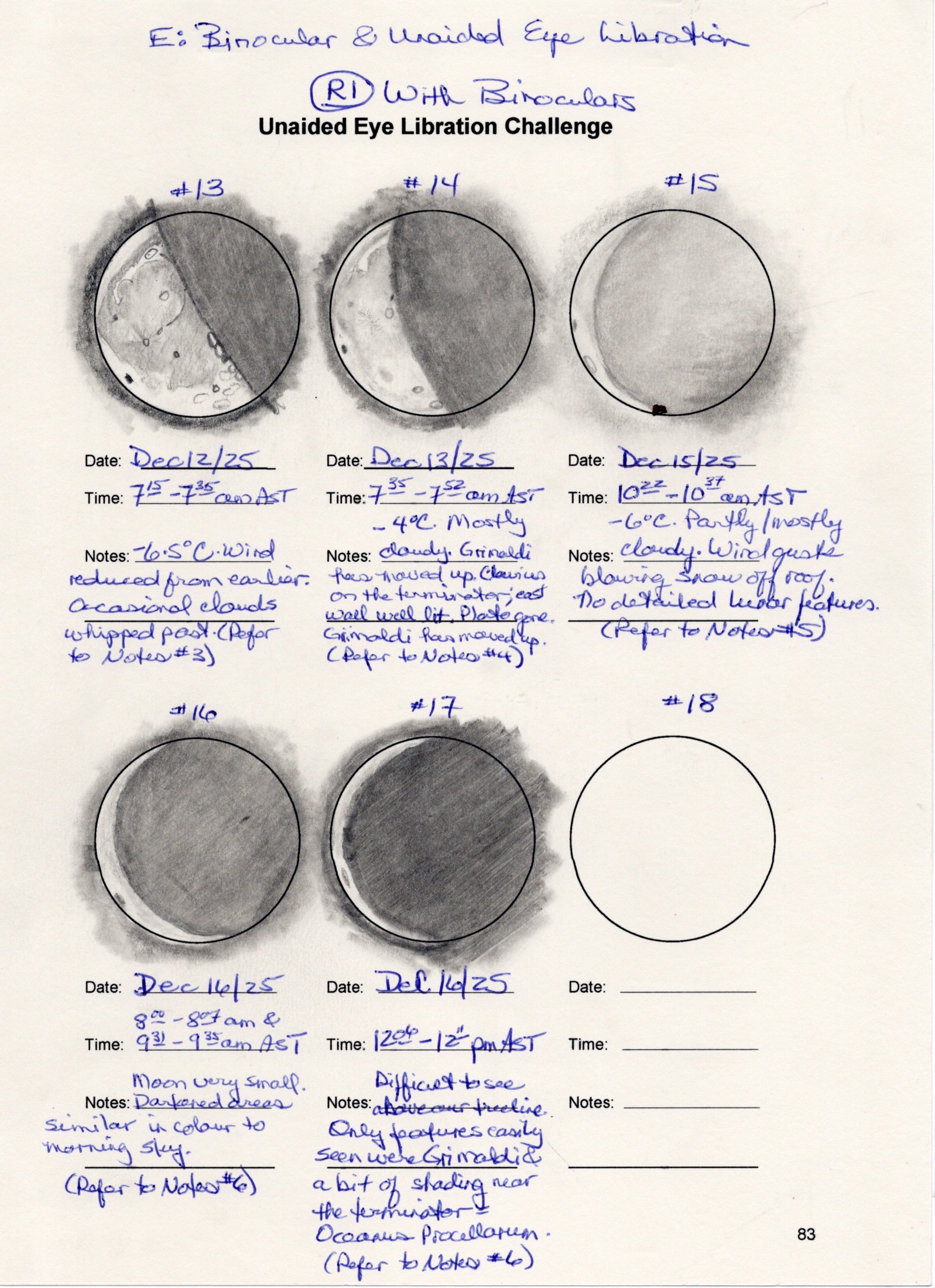
Libration is the apparent "wobbling" of the Moon as observed from Earth which allows us to "peek" around a limb and see up to 59% of its surface.
Required: Using binoculars, note the relative location of Mare Crisium from one part of a lunation to another. Other dark features near the limbs can be used for this activity as well, such as Mare Frigoris to the north, Grimaldi to the west, Mare Australe to the southeast and Mare Humboldtianum to the northeast.
Challenge: Without using binoculars, detect and sketch the libration of the Moon from one lunation to another.
-------
Notes: In order to ensure that I was not 'imagining' a structure on the Moon and to not introduce bias of any sort, I used unaided eye to observe and sketch the Moon first before using my 10x42 IS binoculars to view, identify and sketch structures observed. I did not sketch all unaided eye observations.
|
E: Binocular and Unaided Eye Libration (with binoculars and Challenge: naked eye) |
|||||||
|
Phase |
Date |
Time of |
Time of |
% at time of observation |
Refer to |
Weather conditions |
|
|
New Moon |
Nov 20 (2:48 am – 0.0%) |
7:57 am |
4:26 pm |
|
|
|
|
|
Waxing Crescent |
Nov 21 |
9:00 am |
5:06 pm |
--- |
--- |
Clouds |
|
|
Nov 22 |
9:57 am |
5:54 pm |
--- |
--- |
Rain |
|
|
|
Nov 23 |
10:46 am |
6:52 pm |
--- |
--- |
The times originally cited on this chart were UT not AST – so missed it. |
|
|
|
Nov 24 |
11:27 am |
7:57 pm |
18.4% @ 5:20 pm (Sunset: 4:39 pm) |
R1-#1 |
2° C. No wind, cloud cover gone. Only a few clouds intermittently. |
|
|
|
Nov 25 |
11:59 am |
9:06 pm |
27.0% @ 6:40 pm (Sunset: 4:38 pm) |
R1-#2 |
5° C. Light breeze. Intermittent cloud cover eventually became full cover. |
|
|
|
Nov 26 |
12:25 pm |
10:16 pm |
--- |
--- |
Rain & fog |
|
|
|
Nov 27 |
12:47 pm |
11:28 pm |
45.8% @ 5:00 pm (Sunset: 4:37 pm) |
R1-#3 and C1-#1 |
8° C. Clear skies! Light to no wind. |
|
|
|
First Quarter |
Nov 28 |
1:07 pm |
- |
59.2% @ 11:19 pm (Sunset: 4:36 pm) |
R1-#4 and C1-#2 |
0° C. no Clouds!! Very light wind/breeze. Cold. Just happened to look my bedroom windows before bed. Coat, hat, binocs, sketch pad… out the door! |
|
|
Waxing Gibbous |
Nov 29 |
1:26 pm |
12:40 am |
--- |
--- |
Clouds |
|
|
Nov 30 |
1:45 pm |
1:54 am |
70.6% @1:19 am (Sunset: 4:39 pm) |
R1-#5 and C1-#3 |
Mostly cloudy but viewed Moon in slit between clouds for 10 min. Light breeze. Not enough time to get details at the terminator. Also viewed briefly at 8 pm but couldn’t make out any details due to clouds. |
|
|
|
Waxing Gibbous |
Dec 1 |
2:07 pm |
3:12 am |
85.9% @4:18 pm (Sunset: 4:35 pm) |
R1-#6 and C1-#4 |
5° C. partly cloudy. Light wind. Best view time was with binocs. |
|
|
Dec 2 |
2:33 pm (92.6%) |
4:34 am |
--- |
--- |
--- |
|
|
|
Dec 3 |
3:08 pm |
6:00 am |
--- |
--- |
--- |
|
|
|
Full -Supermoon |
Dec 4 |
3:53 pm |
7:26 am |
--- |
--- |
--- |
|
|
Waning Gibbous |
Dec 5 |
4:53 pm
|
8:45 am |
99.6% @4:22 am (Sunrise: 7:37 am) |
R1-#7 and C1-#5 |
-13° C. Clear skies. Light to gusting wind. |
|
|
Dec 6 |
6:06 pm |
9:51 am |
92.9% @ 11:43 pm (Sunset: 4:34 pm) |
R1-#8 and C1-#6 |
-2° C. Clear skies. Due to having a cold, viewed from indoors. Conjunction: Jupiter quite bright below the Moon. Will be closer tomorrow night. |
|
|
|
Dec 7 |
7:26 pm |
10:40 am |
90.2% @9:45 am (Sunrise: 7:39 am) |
R1-#9 and C1-#7 |
1° C. Cloudy morning with clearing in the west to expose the setting Moon. Seeing good; transparency bordering on poor. |
|
|
|
Dec 8 |
8:46 pm |
11:16 am |
82.1% @ 10:20 am (Sunrise: 7:40 am) |
R1-#10 and C1-#8 |
-11° C. Seeing & transparency quite good. Viewed through living room window. Go to Notes #1. |
|
|
|
Dec 9 |
10:02 pm |
11:44 am |
72.9% @ 10:34 am (Sunrise: 7:41 am) |
R1-#11 |
-8° C. No wind. Clear blue skies. 12 hours after last observation. Go to Notes #2. |
|
|
|
Dec 10 |
11:14 pm |
12:05 pm |
--- |
--- |
--- |
|
|
|
Last Quarter |
Dec 11 |
- |
12:23 pm |
|
|
When we could potentially see the Moon, it dropped low into our backyard trees – and into the oncoming clouds. |
|
|
Waning Crescent |
Dec 12 |
12:21 am |
12:40 pm |
45.4% @ 4:20 am (Sunrise: 7:43 am) |
R1-#12 |
-5° C. A few clouds but otherwise clear. Very windy; blowing snow at ground level. Go to Notes #3 at 4:20 am. |
|
|
44.2% @ 7:15 am (Sunrise: 7:43 am) |
R1-#13 |
-6.5° C. Skies clear in lunar viewing area. Mild wind only. Go to Notes #3 at 7:15 am. |
|
||||
|
Dec 13 |
1:27 am |
12:57 pm |
34.6% @ 7:25 am (Sunrise: 7:44 am) |
R1-#14 |
-4° C. Mostly cloudy but had clear interval to observe. Viewed through kitchen door. Very light breeze. Go to Notes #4. |
|
|
|
Dec 14 |
2:31 am |
1:15 pm |
--- |
--- |
1° C. Cloud, snow, windy. |
|
|
|
Waning Crescent |
Dec 15 |
3:37 am |
1:35 pm |
17.1% @ 10:22 am (Sunrise: 7:46 am) |
R1-#15 |
-6° C. Partly cloudy with gusty wind; snow blowing off the house roof affected transparency (fair to poor) from time to time but seeing was good. Go to Notes #5. |
|
|
Dec 16 |
4:42 am |
1:58 pm |
11.3% @8:05 am (Sunrise: 7:46 am) |
R1-#16 |
-9°C. Perfectly clear skies, no clouds in sight. Go to Notes #6. |
|
|
|
10.9% @ 9:31 am |
-7°C. Clear skies but there’s a high haziness that is affecting transparency. Go to Notes #6. |
|
|||||
|
10.3% @ 12:06 pm |
R1-#17 |
-4°C. Clear skies but high haziness still affecting transparency. Caught it just before it disappeared in our trees. Go to Notes #6. |
|
||||
|
Dec 17 |
5:48 am |
2:27 pm |
--- |
--- |
4°C. Cloudy, windy. Skies cleared mid-afternoon but not before Moon had set. |
|
|
|
Dec 18 |
6:52 am |
3:04 pm |
|
--- |
Perfectly clear skies from sunrise/moonrise onwards. Combination of high haze, the sun rising and the small size of the Moon negated ability to see it. Sunrise @ 7:48 am. I did attempt to locate it at various times to no success: · 7:48 am: 2.5% · 8:52 am: 2.3% · 10:13 am: 2.2% · 10:37 am: 2.1% |
|
|
|
New Moon lunation 1274 |
Dec 19 |
7:52 am Sunrise 7:48 am |
3:50 pm |
|
|
Too small, too low on my horizon before clouds settled in. |
|
Notes #1 (Dec 8/25):
Most of the craters I could identify away from the terminator appeared as bright entities on the lunar surface:
- Trio of Theophilus, Cyrillus, Catharina
- Tycho
- Maurolychus
- Posidonius
Along the terminator were two quite brightly lit features:
- Montes Pyrenaeus was a slight semi-circular very well-lit ridge on the terminator.
- Group of 4 craters with their ridges well illuminated: Hommel, Vlaq, Rosenburg, Pitiscus
Copernicus was a grey colour surrounded by its ejecta that sprayed into Mare Imbrium.
Below Mare Fecunditatis was a long valley/line going east-west. Crossing through this from the southern area of the Mare was a white line that terminated near Tycho. Using a lunar map, discover the “valley” was actually Rupes Altai and Altai Scarp. The north-south white line was potentially ejecta from Tycho.
Notes #2 (Dec 9/25):
The Moon seta later in the morning now. There were some things of note:
1- Bright craters near Mare Humorum: Bright crater above (perhaps Gassendi?), close by in the west (Mersenius?) and slightly NW closer to the rim (Cruger or Lacus Aestatis?)
2- Copernicus still very evident with its ejecta field but seems more centred on the lunar surface viewed now compared to last evening when it was more westerly.
3- Aristarchus in northern Oceanus Procellarum highly reflective!!!
4- More of the northern region exposed above Mare Frigoris that last night. Plate still evident.
5- Grimaldi’s location seems to have shifted from 6:30 o’clock last evening to 9:30 o’clock in this observing session. Perhaps due to differing times of day observed?
Notes #3a (Dec 12/25) at 4:20 am:
The Moon appeared just a little less than half. Worthy of note:
1- Montes Alpes and Montes Apennines were illuminated very well and stood out against the terminator and the mare floor (they are sketched in black not white, just to confuse things).
2- On the lower half and just inside the terminator was a line of 6 craters that seemed to follow the curve of the terminator: Ptolemaeus, Alphonsus, Arzachel, Regiomontanus, Purbach and Walther. May have also identified Deslandres (beside Purbach and Walther) and Thebit as a small darker crater as well.
3- Copernicus’s crater floor was completely illuminated as was its ejecta field. One ‘splash’ appeared to almost reach the Aristarchus Plateau area. Kepler and Enke with their ejecta fields very much in evidence as well.
4- Plato was visible above Mare Frigoris and well away from the terminator.
5- Grimaldi was seen at 7 o’clock on the lunar face.
6- Eratosthenes, at the southern end of Montes Apennines, was illuminated but not as brightly as the mountains adjacent to it. Archimedes was illuminated and well away from the terminator
7- Tycho was found low on the lunar surface. South of it were two craters – Longomontanus and Maginus. Using a lunar map, I was also able to ID Clavius that appeared to have a dark ridge across its lower quarter; referring to a map, it may have been the ridge between it and Blancanus.
8- Two stars could be identified (I think). Given the brightness of the Moon, it was a guess – Zavijava (ß Virgo) and Upsilon Leo.
Notes #3b (Dec 12/25) at 7:15 am:
The Moon appeared visibly smaller. Changes from previous observation worthy of note:
1- Less than half of Montes Alpes that was seen earlier was now visible; still illuminated. A little less of Montes Apennines was now illuminated.
2- Copernicus’s crater floor was illuminated as was its ejecta field. Aristarchus along with Kepler and Enke with their ejecta fields very much in evidence.
3- Grimaldi was now seen at 7:30 o’clock on the lunar face.
4- Plato was now just inside the terminator; the mare floor was partially darkened in the west compared to the same area earlier.
5- Eratosthenes was not as bright and Archimede’s floor was darker. The latter was not far from the terminator compared to before.
6- The line of craters on the southern terminator now had their eastern ridges on the terminator. Their floors were much darker than before.
7- Clavius/Blancanus were closer to the southern rim.
8- Didn’t look for adjacent stars.
Notes #4 (Dec 13/25):
The terminator has certainly moved westerly. The Moon may be librated towards the NE given the lack of territory in the SW? (I checked later; this was the case) Worthy of note:
1- Plato, most of Mare Imbrium now gone from view.
2- Grimaldi has moved up to 8:00 o’clock.
3- Copernicus was located just inside the terminator, its ejecta field not as evident as in previous observations. A short shadow evidenced in the west floor.
4- Kepler and Aristarchus still bright but not “white” more greyish. The extent of Kepler’s west-splashing ejecta field now more evident without the seemingly overlaid Copernicus ejecta field.
5- Clavius located on the lowest point of the crescent, its eastern wall lit up on the terminator. Blancanus also evidenced below it, a darkish line where their rims meet.
6- Tycho quite low. Ejecta not in evidence as much.
7- There was a bright oval patch at about 7 o’clock just inside the rim. Maybe Byrgius?
Notes #5 (Dec 15/25):
Moon barely visible naked eye and was a challenge to find even with binoculars. Not many features could be seen. Mare Frigoris is gone from view. Worthy of note:
1- Grimaldi now almost at 9 o’clock on the lunar surface.
2- Western shoreline of Oceanus Procellarum could be seen just inside the western limb. Copernicus and Kepler are definitely gone from view. Even Aristarchus couldn’t be discerned.
3- There was a bright, long oval patch at about 7:30-8:00 o’clock literally just inside the rim. Again, maybe Byrgius?
4- With binocs could make out most of the lunar circle except for a small section on the SE. No features whatsoever could be seen in the ‘shadow’.
Notes #6 (Dec 16/25):
Three observations today. Unlike yesterday, the lunar limbs could only be seen on the lit western edge. The others blended into the morning skies.
@ 8:00 am: Viewed from outside basement/backyard door. Moon difficult to see naked eye and was a challenge to find even with binoculars. Not many features could be seen. Worthy of note:
1- Grimaldi’s dark patch now back at 8:30 o’clock on the lunar surface.
2- Western limb edge was quite bright; Oceanus Procellarum was not clearly defined and was seen more like a shadow than a mare.
3- No other feature discernible.
@ 9:31 am: Viewed from our kitchen window. Moon could be seen naked eye once found with binoculars. Not many features could be identified. Worthy of note:
1- Grimaldi’s dark patch remains at 8:30 o’clock on the lunar surface.
2- Western limb edge was quite bright.
3- Oceanus Procellarum (OP) was not clearly defined and was seen more like a shadow than a mare. The limb west of OP was quite bright.
4- There was a bright oval patch at about 7 o’clock just inside the rim. Maybe Byrgius?
5- There was a bright patch above Grimaldi at approx. 10 o’clock. Maybe Aristarchus on the limb edge?
@ 12:06 pm: Viewed from our bedroom window just above our tree line. Only 5 minutes to see it before it disappeared in the trees. Worthy of note:
1- Grimaldi’s dark patch remains at 8:30 o’clock on the lunar surface.
2- Western limb edge was quite bright but portion of Moon illuminated changed as the angle of the Moon changed. Couldn’t discern definitive OP shoreline at all; it appeared more as a shading adjacent to the bright limb.
|
Required: Sketches, Page 1 |
Required: Sketches, Page 2 |
|
Required: Sketches, Page 3 |
|
Challenge: Sketches, page 4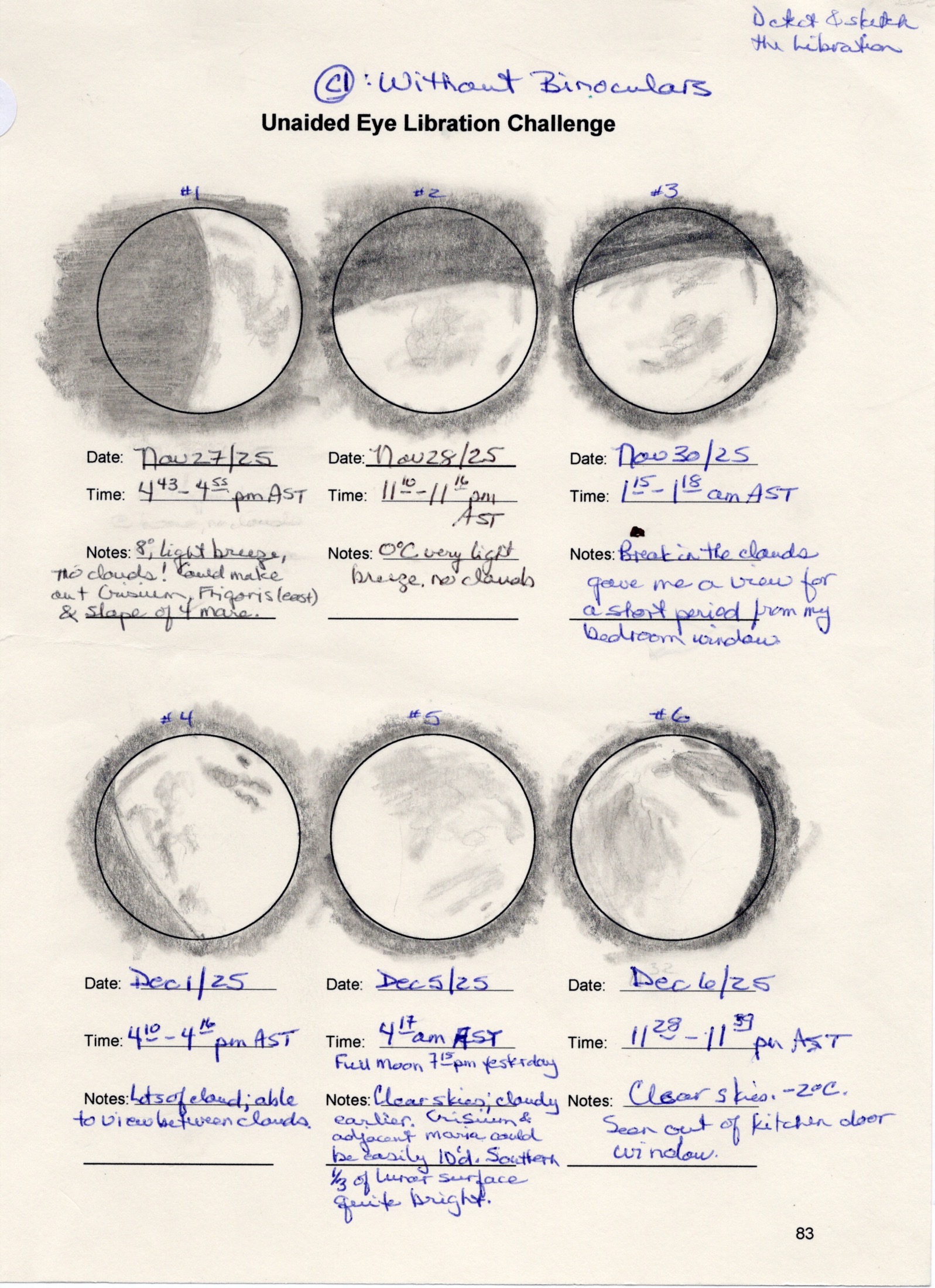 |
Challenge: Sketches, Page 5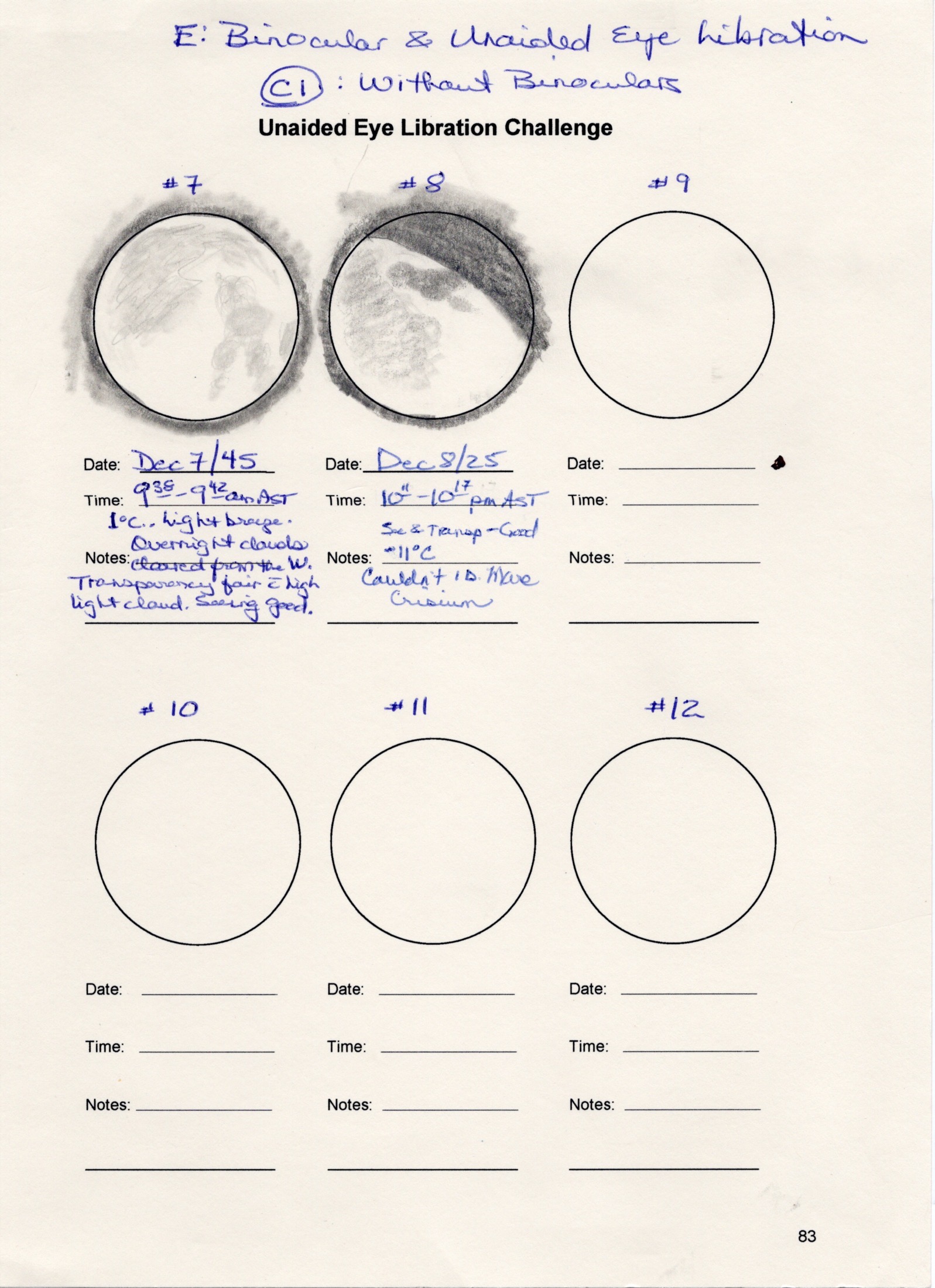 |