IWLOP #001 B – Western Mare Crisium
This spectacular lava-filled basin features impressive wall structures, and is actually oval-shaped but appears round because of its location near the lunar limb. Are Crisium covers 20 degrees of lunar surface, and may require various terminator angles for optimums view of all the features listed. Some of the se objects may be easier to see just after Full Moon.
Location: 17.0 N 70-50 E Origin: Impact and Volcanism Size: 570 km. Rukl: 27, 38 Type: Basin
Objects: Swift, Pierce, Yerkes, Picard, Greaves, Lick
Others Identified: Alhazen, Condorset, Eimmart, Firmicus, Hansen, Lacus Perseverentiae, Mare Anguis
Observation 1:
Location: Home
Date: 2020-05-25
Time: 9:02 PM ADT
Equipment: 6" Dobsonian
Eyepiece: Antares 15 mm Plössl
Magnification: x80
Transparency: Good (3)
Seeing: Good (3)
R1: Swift, Pierce & Picard easily located. Also located Yerkes.
R2: Graves located. The crater walls of Lick barely seen but the crater floor colour gave it definition. The western half of Crisium appears darker than the eastern half.
Observation 2:
Location: Home
Date: 2021-04-15
Time: 8:15 PM ADT
Equipment: 10" Meade SCT
Eyepiece: Explore Scientific 4.7mm with 82° FOV with Moon filter
Magnification: x530
Transparency: Good (3)
Seeing: Very Good (4)
I had sketched Mare Crisium on 2020-05-25 (refer to IWLOP #001 A – Eastern Mare Crisium). On 2021-04-15, I photographed the Mare and the craters identified for this objective. In the photo, it looks like the Mare has two eyes and a crooked smile.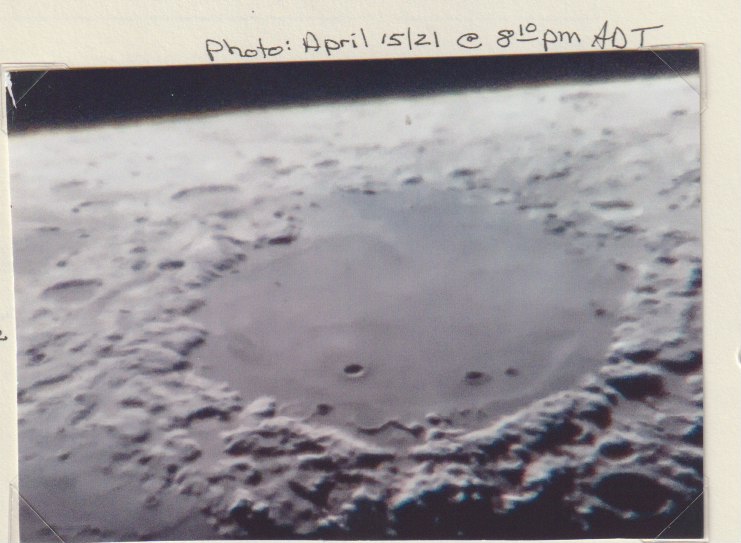
Observation 3:
Location: Home
Date: 2025-10-06
Time: 10:15 PM ADT
Equipment: 10" Meade SCT
Eyepiece: 30mm & 15 mm (SvBony 30-10mm Zoom Eyepiece)
Magnification: x86, x167
Transparency: Good (3)
Seeing: Fair (2)
In viewing Tycho's ray system using the 30mm eyepiece, I noticed that its ray system appeared to cross through the centre of Crisium. At the higher power, I noticed the rays originating in the east from Proclus seemed to have a greater effect. The mountains between Proclus and the Mare were bright and features on that side of the Mare were quite light in comparison to the rest of Mare. The Proclus ejecta field splayed outwards in bands across most of the central area of the Mare.