Crater and system of rilles, the largest of which is clearly visible through a small telescope.
Origin: Impact and Tectonic Diameter: 42 km Rukl: 39,50 Type: Crater & Rill
Objects: Sirsalis, Sirsalis A, Rima Sirsalis, Sirsalis (J, F, G, H), Crüger, Rimae Darwin
Others Identified: Darwin
Location: Home
Date: 2018-09-06 + 2019-04-17 + 2020-08-30
Time: 6:30 PM ADT + 9:50 PM AST + 9:15 PM ADT
Equipment: 6” Sky-Watcher Dobsonian
Eyepieces: Meade Super Plössl 9.7mm, Explore Scientific 4.7mm
Magnification: x120, x255
Seeing: Good (3)
Transparency: Good (3)
Observation #1:
Date: September 6, 2018
R1: Sirsalis and Sirsalis A are SE of Grimaldi.
R2: Rimae Sirsalis is located SE of Sirsalis and appeared as a dark line on the lunar surface. I was able to follow it to near/below the crater Darwin.
Observation #2:
Date: April 17, 2019
C1: I was able to locate the secondary craters Sirsalis J, F, G and H.
Observation #3:
Date: August 30, 2020
C2: Finally located the Rimae Darwin! It intersected Rimae Sirsalis that ran from Sirsalis/Sirsalis A south to the crater Darwin. It took a bit of time to see this but it was worth the time to adapt to the brightness to discern the rimae.
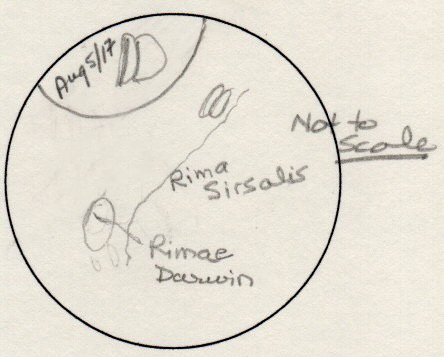
in the FOV and ‘darker’ than the surrounding terrain.
Refer to Explore the Moon (Telescope) – August 5, 2017 for further details.